
Announcement Description
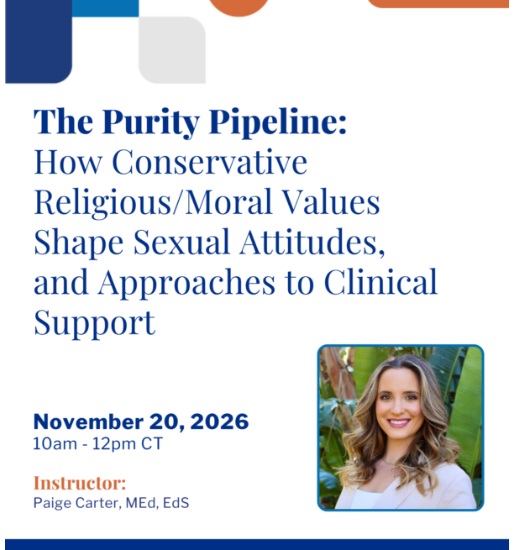
The Purity Pipeline: How Conservative Religious/Moral Values Shape Sexual Attitudes, and Approaches to Clinical Support
Presented by Paige Carter, MEd, EdS
Friday, November 20, 2026
8am-10am PT / 10am-12pm CT / 11am-1pm ET
Event held online via Zoom, link to access provided upon registration.
Psychosexual development is an important factor that contributes to overall youth wellness (Kotiuga et al., 2021). However, evidence suggests that experiences of psychosexual development may vary, with common developmental patterns potentially including the adoption of maladaptive or unhealthy sexual and relational attitudes (Daniels et al., 2020; Kotiuga et al., 2021; Ramiro-Sánchez et al., 2018). Negative sexual and relational attitudes may include endorsement of rape myths, confusion, fear, and anxiety, which are also associated with mental, sexual, and relational health outcomes, including depression, anxiety, disordered eating behaviors, body image issues, sexual wellness, and relationship aspects, such as commitment (Gillen & Markey, 2019; Saint-Eloi Cadely et al., 2020; Zhang & Liu, 2020). The consequences of these attitudes is reflected in the pervasive prevalence of sexual violence and child sexual abuse, the persistence of rape myths and victim-blaming across social and institutional contexts, and the emergence of online subcultures – including incel and broader manosphere communities – that can reinforce misogynistic and sexually violent beliefs (Bouillaut et al., 2026; Fang et al., 2026; PettyJohn et al., 2026). Sexual and relational attitudes develop from a multitude of sources, including institutional policies that aim to regulate sex and sexuality (i.e., formal sex education in schools, access to sexual healthcare) and other cultural and social influences, such as religious organizations and immediate social networks (Garney et al., 2021; Kaestle et al., 2021). Through various forms of media, attitudes towards sex, sexuality, and relationships that are shaped by institutional, cultural, and social factors are promoted on a broad scale, often disseminating conflicting stances that may confuse developing youth, negatively impacting their sexual and relational attitudes and behaviors (Santoniccolo et al., 2023). While multiple sources may contribute to the development of youth’s sexual and relational attitudes, one such moral and religious sociocultural environment that may broadly impact all sources is purity culture (Gish, 2018; Natarajan et al, 2022). Purity culture is a moral and religious sociocultural environment rooted in Christian theology that targets youth with messaging about sex and sexuality, gender roles, and modesty (Klement & Sagarin, 2017; Natarajan et al., 2022). While purity culture stems from conservative, Christian teachings, purity values have been adopted in broader culture through their integration into conservative political platforms that have successfully implemented laws and policies shaped by purity ideology (Gish, 2018; Klement et al., 2022). Additionally, purity culture values are evident in mainstream social and cultural environments, with celebrities and social media influencers having championed purity ideology that promotes sexual conservatism, traditional gender norms, and strict guidelines that determine expectations for appearance and behavior (Macy Burkett, 2024). Researchers demonstrate that exposure to purity culture may negatively impact sexual and relational attitudes and experiences and increase risk of mental and sexual health issues (Benton, 2022; Hardy & Willoughby, 2017; Muskrat et al., 2025; Sawatsky et al., 2024).
In this webinar, the audience will learn the importance of psychosexual development in youth for overall well-being and will identify the various sources that contribute to this development. The audience will gain knowledge of how purity culture has influenced broader sociocultural attitudes towards sex and sexuality that may negatively impact youth’s sexual and relational attitudes and behaviors. Through defining various concepts related to sex, sexuality, and relationships, the audience will be able to assist youth in critically examining their sexual and relational attitudes to inform their psychosexual development and promote healthy sexual and relational attitudes and behaviors.
Zoom link will be available on course page in “My Courses” upon event registration.
This program, when attended in its entirety, offers 2.0 CEs for Psychologists, 2.0 IL CEUs for Counselors and Social Workers, 2.0 BBS California CEUs for LPCCs, LPSWs, and LMFTs, 2.0 AASECT CEUs for Sex Educators, Counselors, and Therapists, or 2.0 NBCC Clock Hours.
Price: $50.00
Link: https://tcsppofficeofce.com/product/the-purity-pipeline-how-conservative-religious-moral-values-shape-sexual-attitudes-and-approaches-to-clinical-support/
Photo Gallery
Announcement Video