
Announcement Description
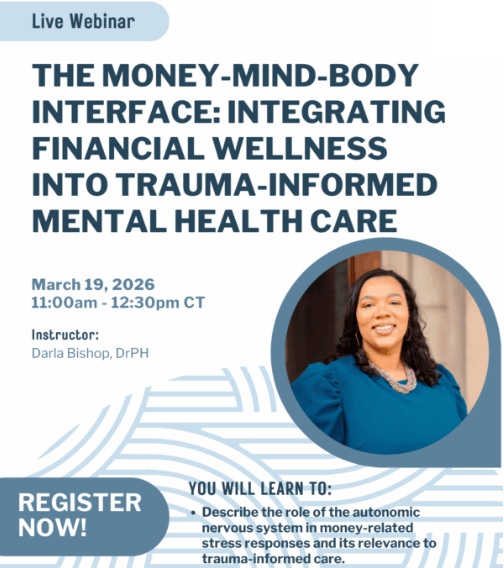
The Money-Mind-Body Interface: Integrating Financial Wellness into Trauma-Informed Mental Health Care
Presented by Darla Bishop, DrPH
Thursday, March 19, 2026
9am-10:30am PT / 11am-12:30pm CT / 12pm-1:30pm ET
Event held online via Zoom, link to access provided upon registration.
Financial trauma can activate neurobiological stress responses similar to those observed in other trauma exposures, including hypervigilance, avoidance, emotional dysregulation, and feelings of helplessness. Chronic financial stress functions as a persistent stressor that impacts autonomic nervous system regulation and increases allostatic load, often compounding existing trauma histories and interfering with stabilization and treatment engagement (Bonaz et al., 2024; Shchaslyvyi et al., 2024; Williamson et al., 2015). This program is designed to help clinicians recognize and respond to money-related stress as it shows up in real clinical practice. Participants will learn how financial stress commonly presents in session—through avoidance of care tasks, emotional flooding during goal-setting, shame-based narratives, and difficulty with follow-through—and how to differentiate financial stress responses from resistance or lack of motivation (Lokshina et al., 2021; Ross & Coambs, 2018).
The session provides concrete strategies clinicians can use to assess financial stress, name it in trauma-informed language, and support nervous system regulation when money-related triggers emerge. Using a research-informed Money–Mind–Body framework, the program offers practical tools that fit within existing therapeutic models, including brief assessment prompts, regulation strategies, and ethical language for discussing financial stress without providing financial advice. Clinicians will learn how to integrate financial wellness considerations into treatment planning in ways that reduce shame, support client agency, and improve engagement, while maintaining appropriate professional boundaries and referral practices (Sholin et al., 2021; Ross & Coambs, 2018). The goal is not to turn mental health professionals into financial counselors, but to equip them with clinically appropriate, immediately usable skills that support safety, stabilization, and forward movement in treatment.
Zoom link will be available on course page in “My Courses” upon event registration.
This program, when attended in its entirety, offers 1.5 CEs for Psychologists, 1.5 IL CEUs for Counselors and Social Workers, 1.5 BBS California CEUs for LPCCs, LPSWs, and LMFTs, or 1.5 NBCC Clock Hours.
Price: $30.00
Photo Gallery
Announcement Video